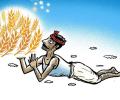
India's policy for agriculture trade must move commodity-by-commodity to gain maximum benefits as US President Donald Trump's 26 per cent tariff on exports from the country take effect, said agriculture economist Ashok Gulati in a recent policy paper.

Skymet expects a good monsoon over western and southern India.

Seafood is one of India's largest agricultural exports after basmati rice and buffalo meat.
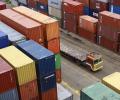
The US Trade Representative noted that India's average applied tariff rate stood at 17% per cent, the highest of any major world economy.
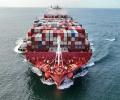
'Reciprocal tariffs are not going to affect India except specific sectors and there are opportunities to capture.'

Since India relies heavily on specialised imported fasteners for critical applications in industries, such as automobiles, aerospace, electronics, and defence, their sudden unavailability will jeopardise production.

'And America will invite India in to have really an extraordinary opportunity and relationship with us.'
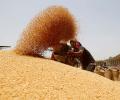
Wheat production during the current season is expected to be better than last year provided the weather remains favourable over the next few weeks, said senior industry executives. The weather had turned uncharacteristically hot in the latter half of last month, but owing to strong winds, the chill has returned in the last few days.
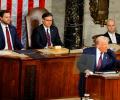
I'...additional concessions, such as opening government procurement, reducing agricultural subsidies, weakening patent protections, and allowing unrestricted data flows -- demands India has resisted for decades.'
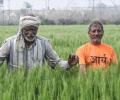
'Rainfall does not appear to have a statistically significant impact on foodgrain production since the last few years, which contrasts with the traditional view of India's heavy reliance on monsoon rains for agriculture.'

'Every Indian should move to an EV, and the government should not buy any fossil fuel cars. The government should become the first driver of EV adoption.'
'The size of the investments is important, but equally crucial is the number of jobs that these proposals create.'

'The US has agreed to negotiate with us a mutually beneficial bilateral trade agreement, which will go for reduction of tariffs on both sides so that our trade can grow.'

Ahead of the visit, officials from key government departments held intense discussions to identify key trade-related proposals.

'For the Indian economy to maintain a growth rate of 7 to 8 per cent, it needs large foreign direct investment coming in, and that's mainly coming from the US.'

'We have to be prepared for the larger disruption that is likely to take place.'
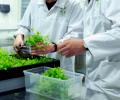
Several leading scientists, academicians, and agriculturalists have called for raising government support for research and development to make Indian agriculture future-ready.
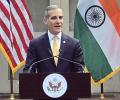
'...I'll say this to my fellow Americans, the more ties that we have to more Indians and the more ways we can find to grow our economic and educational exchanges, the stronger America and India.'
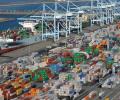
The Federation of Indian Export Organisations (FIEO), the apex body for exporters, is formulating a strategy for five key sectors to boost exports to the United States (US), as President-elect Donald Trump has threatened to impose high tariffs on Chinese goods. "This time, we need to be proactive instead of reactive.
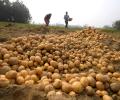
Amid the political blame game over Bengal's potato ban, which led to shortages in Jharkhand and Odisha, Uttar Pradesh farmers are the unlikely winners.
 © 2026 Rediff.com - Advertise with us - Disclaimer - Privacy Policy - Sitemap - Feedback - About us - Terms of use - Grievances